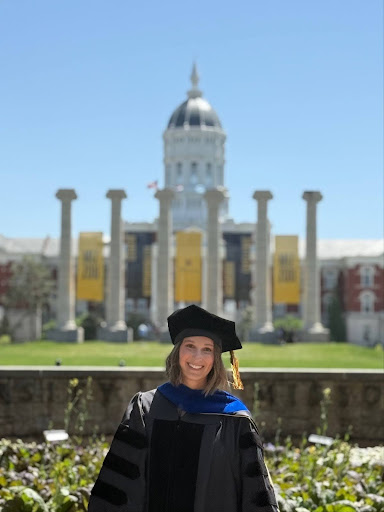
Phd Graduate Accepts Curatorial Position At Cincinnati Art Museum
This year, Audrey Florey is serving as a Curatorial Assistant, supporting the Curator of American Paintings, Sculpture & Drawings. In this role, they contribute to a wide range of curatorial responsibilities, including researching, writing about, and documenting collection objects; assisting with the planning and development of exhibitions; and managing publications through manuscript preparation, rights coordination, and proofreading. Working collaboratively with museum staff across departments, they also support acquisitions through research, writing, and cataloging, present both scholarly lectures and public gallery talks, participate in donor stewardship, and educate docents and volunteers on the department’s collection areas and exhibitions.
Their doctoral research closely informs their curatorial practice. Their dissertation examined three women artist-educators of distinct racial, ethnic, and artistic backgrounds as case studies, highlighting the socially conscious art initiatives these artists developed and how their work helped democratize the twentieth-century American art world. Artist-educators—those who both actively create art and teach—played a vital role in shaping the visual arts landscape through artistic production, pedagogy, and institutional leadership.
By examining the work of Wisconsin craftsperson Elsa Ulbricht, Indigenous ceramicist Otellie Loloma, and African American painter and printmaker Samella S. Lewis, the research demonstrates that women artist-educators helped create a far more inclusive and diverse art world than is often represented in textbooks. Through the Works Progress Administration’s Milwaukee Handicraft Project, Ulbricht professionalized working women of varied backgrounds by equipping them with essential industrial skills while producing art-craft objects for public institutions. At the Institute of American Indian Arts, Loloma advanced contemporary approaches to Indigenous artmaking that challenged settler perceptions and empowered future generations of Native artists. Lewis founded cultural institutions and academic frameworks that were instrumental in establishing an African American art history canon.
Drawing on extensive archival research, the dissertation analyzes each artist’s body of work, pedagogical methods, and institutional contributions to show how women artist-educators of different identities used art education to gain access to the mainstream art world while sharing similar teaching philosophies and artistic ideologies rooted in social consciousness.
At the core of their research—and their professional practice—is a belief that museums are educational spaces that should serve the public. The dissertation emphasizes how women artist-educators fostered a more democratic art world through the creation of educational and institutional spaces, such as Samella S. Lewis’s role in developing the Museum of African American Art in Los Angeles. They are also deeply committed to interdisciplinary collaboration, particularly between curatorial and education departments, a value they continue to bring into their work at CAM.